
Beyond Validity: SVAR Identification Through The Proxy Zoo
Last Update:
This paper develops a framework for robust identification in SVARs when researchers face a zoo of proxy variables. Instead of imposing exact exogeneity, we introduce generalized ranking restrictions (GRR) that bound the relative correlation of each proxy with the target and non-target shocks through a continuous proxy-quality parameter. Combining GRR with standard sign and narrative restrictions, we characterize identified sets for structural impulse responses and show how to partially identify the proxy-quality parameter using the joint information contained in the proxy zoo. We further develop sensitivity and diagnostic tools that allow researchers to assess transparently how empirical conclusions depend on proxy exogeneity assumptions and the composition of the proxy zoo. A simulation study shows that proxies constructed from sign restrictions can induce biased proxy-SVAR estimates, while our approach delivers informative and robust identified sets. An application to U.S. monetary policy illustrates the empirical relevance and computational tractability of the framework.
What is a proxy zoo and generalized ranking restrictions
A popular identification strategy for SVARs relies on external instruments (proxies) to identify structural shocks, which requires that the chosen proxy is perfectly orthogonal to all non-target shocks. Decades of macroeconometric research have led to a proliferation of proxies intended to identify the same structural shock—a proxy zoo—constructed using different data sources and methodologies, and to a central debate over proxy exogeneity.
We replace the binary notion of “valid vs. invalid instrument” with a proxy-quality parameter that measures how much more a proxy correlates with the target shock than with any non-target shock. We then impose generalized ranking restrictions (GRR) with the proxy-quality parameter: For each proxy $m_{\ell,t}$ targeting at the shock $\epsilon_{1,t}$ with quality $\tau_{\ell,0}$, we have
\[\mathrm{corr}(m_{\ell,t},\epsilon_{1,t}) \ge \tau_{\ell,0}\, \big|\mathrm{corr}(m_{\ell,t},\epsilon_{j,t})\big|,\quad j\ge 2\]This bounds the correlation with non-target shocks by at most $1/\tau_{\ell,0}$ times the correlation with the target shock.
To limit researcher discretion, we use a common $\tau$ for all proxies.
Learning from the zoo
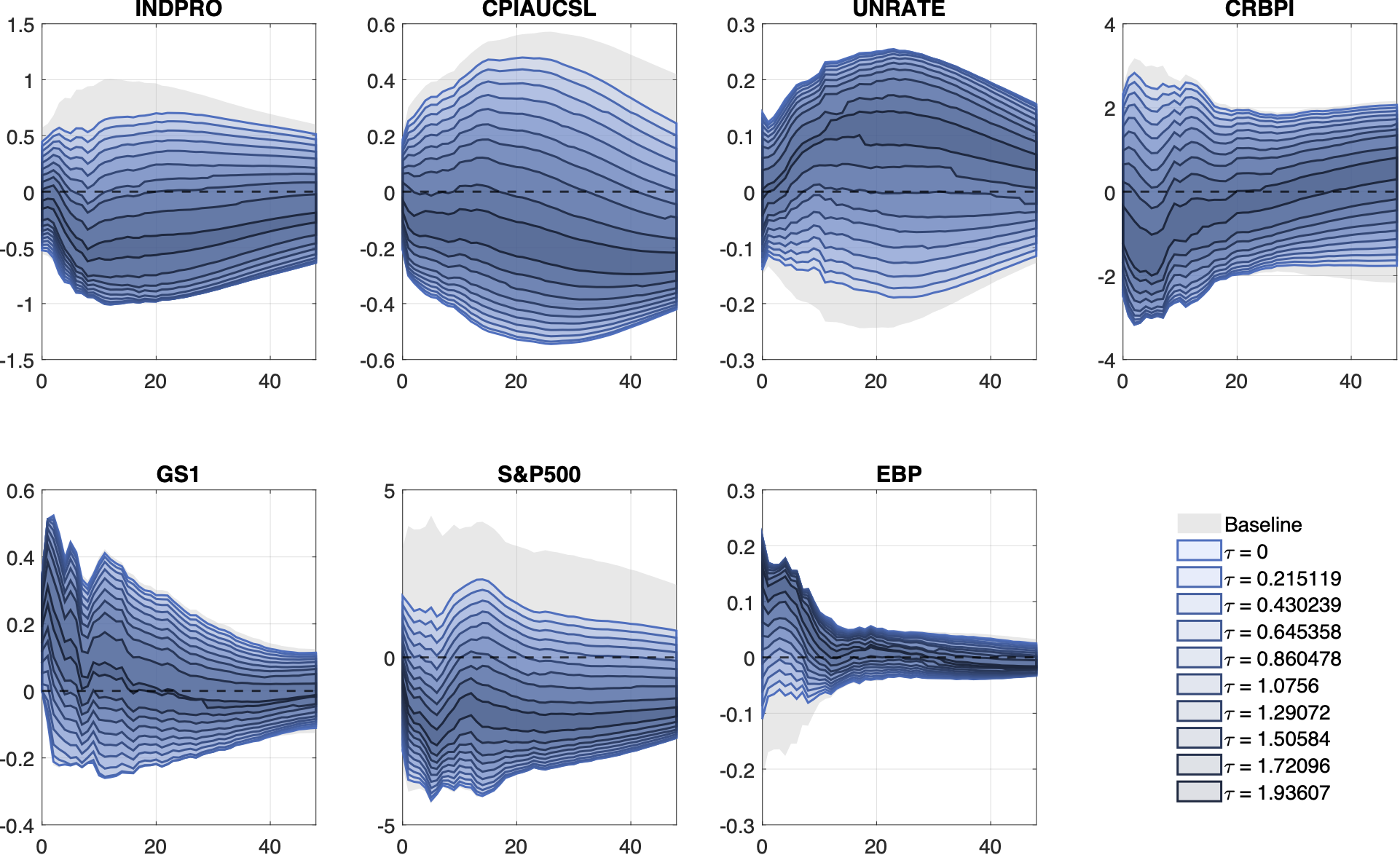
The parameter $\tau$ captures the researcher’s belief about proxy quality. As $\tau \to \infty$, GRR reduces to standard exogeneity; at $\tau = 1$, proxies need to be more correlated with the target shock than with any non-target shock; at $\tau = 0$, proxies only need to be correlated with the target shock. Larger $\tau$ implies stronger assumptions and a narrower identified set. With multiple proxies of heterogeneous quality $\tau_\ell$, sensitivity analysis amounts to varying the minimum quality $\tau_0 = \min_\ell \tau_{\ell,0}$ across proxies.
Bounding proxy quality
Crucially, proxy quality can be learned from the data rather than calibrated ex ante. Two sources of falsifiable information emerge:
- auxiliary restrictions—once sign or narrative constraints are imposed, the data restrict which contamination levels are compatible with those restrictions; and
- proxy complementarity—when proxies carry conflicting information, joint feasibility restricts admissible quality levels without parametric modeling of endogeneity.
Together, these yield $\bar{\tau}$, a data-dependent upper bound on $\tau_0$.
Application to U.S. monetary policy
We apply the framework to U.S. monetary policy using eight proxies spanning narrative (RR), high-frequency (GSST, GK, NS), information-controlled (MR, BS), sign-restricted (JK), and unified (BRW) approaches.
Key findings:
Exact exogeneity is rejected. The data imply a finite upper bound $\bar{\tau} = 2.15$, indicating that the joint restrictions are incompatible with exact exogeneity for all proxies simultaneously.
Informative bounds without valid IVs. The claim that output and inflation both fall on impact requires $\tau \geq \tau^* = 1.88$–proxies must correlate roughly twice as strongly with the target shock as with any non-target shock. This is substantially weaker than exact exogeneity ($\tau = \infty$).
Heterogeneous proxy informativeness. Leave-one-proxy-out (LOPO) analysis reveals that the Nakamura-Steinsson (NS) proxy drives most of the identification: excluding it reduces informativeness by 21 percentage points. Several other proxies (e.g., MR) contribute negligibly once the zoo is considered jointly.
Table 1. Proxy Information Analysis (LOPO)
| Excluded Proxy | MR | BS | RR | GSST | GK | NS | JK | BRW | None |
|---|---|---|---|---|---|---|---|---|---|
| $\kappa(\mathcal{M},\tau^{\ast})$ | 0.87 | 0.82 | 0.82 | 0.82 | 0.78 | 0.65 | 0.85 | 0.78 | 0.86 |
| $\Delta_{\ell}(\tau^{\ast})$ | 0.00 | 0.04 | 0.04 | 0.05 | 0.08 | 0.21 | 0.01 | 0.08 | 0.00 |
Notes: Each column reports (relative) information measures for the proxy zoo excluding the specified proxy, evaluated at the breakdown value $\tau^{\ast}=1.88$. Row $\kappa(\mathcal{M},\tau^{\ast})$ measures the information of the corresponding proxy zoo, and Row $\Delta_{\ell}(\tau^{\ast})$ measures the relative information of each excluded proxy. Higher values of $\Delta_{\ell}(\tau^{\ast})$ indicate that the excluded proxy contributes more to tightening identification.